

Artificial intelligence is no longer a futuristic concept tucked away in tech labs — it’s sitting in your inbox, drafting your contracts, screening your job applicants, and analyzing your customer data right now. For business owners, that’s exciting. But it also raises a pile of legal questions that most companies aren’t fully prepared to answer.
2025 has brought a sharper regulatory focus on AI than any previous year. Lawmakers, courts, and regulatory agencies across the US and globally are catching up to the technology — and the rules are shifting fast. Whether you’re a small business using an AI chatbot for customer service or a large enterprise deploying machine learning in your hiring process, understanding the legal landscape isn’t optional anymore. It’s risk management.
This article breaks down the core legal issues that AI creates for businesses in 2025, what you actually need to pay attention to, and where the law currently stands on the most pressing questions.
The Regulatory Environment in 2025: What’s Changed
The legal framework around AI has evolved considerably. In 2024, the EU AI Act became the world’s first comprehensive AI regulation, classifying AI systems by risk level and imposing strict obligations on high-risk applications. While this is EU law, it has direct implications for any US-based company doing business in Europe — and it’s shaping how American regulators are thinking about the space.
In the United States, the regulatory picture is more fragmented. There’s no single federal AI law yet, but existing laws are being actively applied to AI-related conduct. The FTC has been clear that it considers deceptive or unfair AI practices within its jurisdiction. The EEOC has issued guidance on AI in employment. The Consumer Financial Protection Bureau has addressed AI in lending decisions. And state-level legislation is proliferating rapidly — Colorado, Texas, and Illinois have all passed laws touching AI in specific contexts.
What this means for your business is that the legal obligations around AI aren’t hypothetical. They’re already here, scattered across multiple agencies and jurisdictions, and they apply to you whether or not you built the AI tool you’re using.
Intellectual Property: Who Owns AI-Generated Work?
One of the most practically significant legal questions for businesses using AI is the ownership question. If your marketing team uses an AI tool to generate copy, images, or code, who owns that output?
The US Copyright Office has maintained a consistent position: copyright protection requires human authorship. Works generated autonomously by AI — without sufficient human creative input — are not eligible for copyright protection. This was confirmed again in the Thaler v. Perlmutter case, where a federal court upheld the Copyright Office’s refusal to register an image created entirely by an AI system.
The practical implications are significant:
- Content your business creates using AI may be unprotectable, meaning competitors could legally copy it.
- The degree of human involvement matters. If a human significantly edits, arranges, or creatively transforms AI output, there may be some protectable expression in the final result.
- Vendor agreements need scrutiny. When you use third-party AI tools, the terms of service often include provisions about ownership of outputs. Read them carefully.
On the flip side, AI training data raises infringement concerns of its own. Several high-profile lawsuits — including cases brought by news publishers and visual artists against major AI developers — allege that training large language models on copyrighted works constitutes infringement. If you’re developing or fine-tuning your own AI systems, the legal risk around training data is real and still unsettled in the courts.
Data Privacy and AI: A Collision Course
AI systems are hungry for data. They need it to function, to learn, and to improve. But the data businesses feed into AI tools is often personal — customer information, employee records, financial data, health information. That creates direct tension with privacy law.

What Privacy Laws Apply to AI Use?
In the US, there’s no single federal privacy statute, but a patchwork of laws applies depending on your industry and the states where you operate. The California Privacy Rights Act (CPRA) is particularly relevant — it gives California consumers the right to opt out of automated decision-making and requires businesses to disclose when automated technology is being used to make significant decisions about them.
Several states have followed California’s lead. Virginia, Colorado, Connecticut, and Texas have all enacted comprehensive privacy laws with provisions that touch on automated decision-making and profiling. If your business uses AI to make or inform decisions about individuals — credit, employment, marketing — these laws likely apply to you.
The Risk of Third-Party AI Tools
A common and underappreciated risk: when businesses plug customer or employee data into third-party AI platforms, they may be sharing that data with the vendor in ways that violate their own privacy policies or applicable law. Many AI tools use submitted data to improve their models unless you specifically opt out — a default that many business users don’t notice until it’s too late.
Before deploying any AI tool that processes personal information, businesses should review the vendor’s data processing agreement, understand how input data is stored and used, and ensure that the arrangement is consistent with their legal obligations to employees and customers.
AI in Employment: Discrimination and Liability
Employment is one of the highest-risk areas for AI use from a legal standpoint. Businesses are increasingly using AI to screen resumes, assess candidates, monitor employee performance, and even predict turnover. Each of these applications carries potential liability under existing employment discrimination law.
The core problem is what’s known as algorithmic discrimination. AI systems trained on historical data can encode and perpetuate patterns of discrimination even when the developers had no discriminatory intent. A hiring algorithm trained on past successful hires at a company that historically employed mostly men, for example, may systematically disadvantage female applicants — a Title VII problem regardless of intent.
The EEOC has made clear that employers are responsible for the discriminatory effects of AI tools they use in employment decisions, even if those tools were built by a third party. The “vendor did it” defense isn’t a defense at all under federal civil rights law.
Illinois was the first state to specifically regulate AI in hiring with the Artificial Intelligence Video Interview Act, requiring employers to notify applicants when AI is used to analyze video interviews and obtain consent. Other states are expected to follow. Employers using AI-assisted hiring tools should:
- Audit the tools for disparate impact on protected classes
- Review vendor contracts for indemnification provisions related to discrimination claims
- Maintain human oversight of consequential hiring decisions
- Document the criteria and processes used in AI-assisted decisions
Liability When AI Gets It Wrong
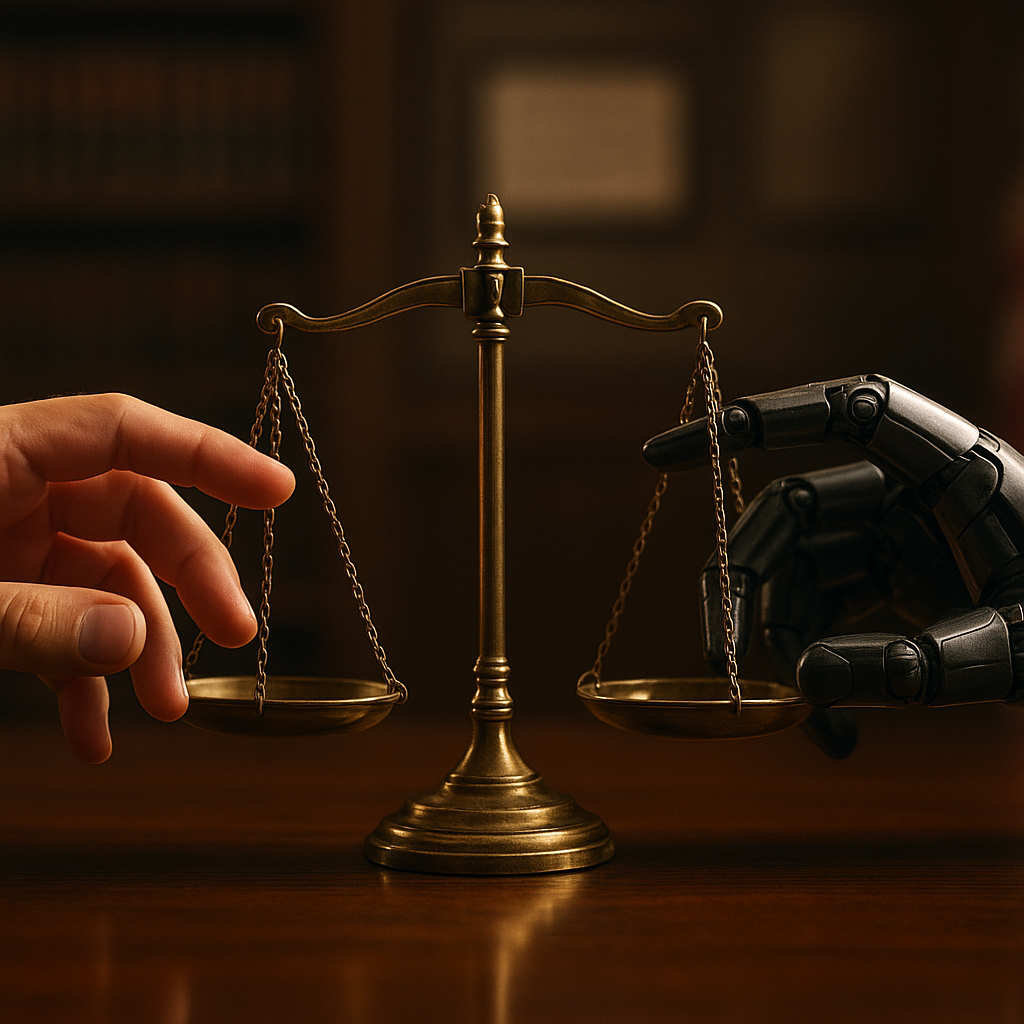
What happens when an AI system makes a mistake that harms someone? This is one of the genuinely novel legal questions that courts and legislatures are still working through.
Traditional product liability law is designed around physical products — it doesn’t map cleanly onto software that learns and changes over time. Contract law and negligence principles can apply in some circumstances, but who’s responsible — the AI developer, the business that deployed it, or some combination — often isn’t clear.
Consider a few scenarios:
- An AI customer service chatbot gives a customer incorrect information about a product that causes harm. Is the business that deployed the chatbot liable? Almost certainly yes, since the chatbot was acting as the business’s agent.
- An AI medical diagnostic tool used by a healthcare provider gives an incorrect diagnosis. Liability could fall on the provider, the AI developer, or both depending on the circumstances and how the tool was marketed and implemented.
- An AI-generated legal or financial document contains errors that lead to financial loss. The business that used the AI to produce the document and the vendor are both potentially in the frame.
The key legal insight here is that using AI doesn’t transfer your legal obligations to the AI. If you use an AI tool in your business operations, you retain responsibility for the consequences of how it’s used. Due diligence, human oversight, and clear contractual allocation of risk with AI vendors are essential risk management steps.
Contracts, Disclosures, and Transparency Obligations
An emerging and underappreciated area of AI law involves disclosure obligations — specifically, when are businesses legally required to tell people that AI is involved in their interactions or decisions?
In several states, there are already disclosure requirements for AI-generated content in political advertising. In consumer contexts, the FTC’s prohibition on deceptive practices effectively requires businesses not to misrepresent whether they’re using AI in ways that would matter to consumers. Several states have introduced or passed laws requiring disclosure when consumers are interacting with AI rather than a human. Understanding your obligations here is part of a broader picture of consumer protection laws and rights that businesses must navigate.
From a contract law perspective, questions are also arising about AI-generated contracts — specifically around formation, interpretation, and whether parties understood what they were agreeing to when AI systems participated in drafting or negotiating terms. When AI tools assist in producing contractual language, it becomes even more important to carefully review the fine print before any agreement is finalized.
Businesses would be well-served to develop clear internal policies on AI disclosure — both for external customer-facing uses and internally for employees. Transparency isn’t just an ethical choice; in 2025, it’s increasingly a legal requirement.
Practical Steps Businesses Should Be Taking Now
Given the breadth and complexity of AI-related legal risk, the following steps represent a reasonable starting point for most businesses:
- Conduct an AI inventory. Know what AI tools are being used in your organization, by which departments, and for what purposes.
- Review vendor contracts. Pay particular attention to data usage, IP ownership of outputs, liability allocation, and indemnification provisions.
- Map your regulatory exposure. Identify which laws apply to your AI use based on your industry, the states you operate in, and the jurisdictions of your customers.
- Implement governance policies. Establish internal guidelines for appropriate AI use, including human oversight requirements for high-stakes decisions.
- Train your team. Employees using AI tools need to understand both the capabilities and the legal risks, including data privacy obligations and disclosure requirements.
- Document everything. In the event of a legal dispute, documentation of your AI processes, oversight mechanisms, and decision-making will be critical.
Conclusion
AI offers genuine business value — that’s not in doubt. But the legal landscape surrounding it in 2025 is complex, evolving, and already generating real liability for companies that haven’t thought carefully about their exposure.
The core themes are consistent across different areas of law: businesses remain responsible for what their AI systems do; existing laws around discrimination, privacy, consumer protection, and intellectual property apply to AI use even without AI-specific legislation; and transparency and human oversight are the recurring hallmarks of legally defensible AI deployment.
The companies that will navigate this environment most effectively aren’t necessarily those with the most sophisticated AI — they’re the ones that treat AI governance as a serious business function, understand their regulatory obligations, and build accountability into how they deploy these tools. The legal questions AI raises are genuinely hard, but ignoring them is significantly harder on the other side of a regulatory investigation or civil lawsuit.